




Human and Humanoids: Toward Human-Robot Coexistence
 Location: Grand Ballroom E-K
 Time: October 5, 2026 | 10:30 AM - 12:00 PM
Overview
As advances in artificial intelligence and robotics accelerate the capabilities of humanoid robots, we are approaching a future in which humans and intelligent machines will increasingly share workplaces, public spaces, and everyday environments. This raises important technological and societal questions about how humans and humanoid robots will work together, interact, and coexist.
This panel brings together experts from the humanoid robotics industry and academia to explore the current state and future direction of humanoid robotics. The discussion will span applications in industrial manufacturing, social robotics, entertainment, assistive technologies, and accessibility, while also addressing challenges associated with human-robot interaction, autonomy, safety, trust, and societal acceptance.
Drawing on perspectives from both industry and research, the panel will examine what humanoid robots can realistically accomplish today, how advances in AI may expand their capabilities, and what technological and human-centered challenges must be addressed as humanoids become increasingly integrated into society.
The panel will provide an opportunity for the IEEE SMC community to engage in a forward-looking discussion about the evolving relationship between humans and humanoid robots - and what meaningful human-robot coexistence may look like in the years ahead.
Key Discussion Themes
 |
|
|
Evolving human–humanoid relationships |
|
|
|
|
Organizer and Moderator
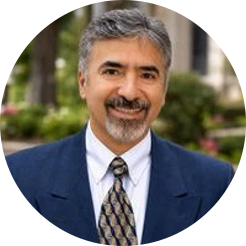
Ferat Sahin - Professor, Rochester Institute of Technology; Vice President, Human-Machine Systems, IEEE Systems, Man, and Cybernetics Society
Bio: Dr. Ferat Sahin is Professor and Department Head of Electrical and Microelectronics Engineering at Rochester Institute of Technology (RIT), where he directs the Multi-Agent Bio-Robotics Laboratory and the Century Mold Collaborative Robotics Laboratory. He received his M.S. and Ph.D. degrees from Virginia Tech and joined RIT in 2000.
His research focuses on human-robot collaboration, collaborative and humanoid robotics, AI-driven manufacturing, physiological and affective computing, trust in automation, machine learning, and system-of-systems engineering. His recent work explores human-aware robotic systems, multimodal estimation of human comfort and workload, augmented reality and digital twins for industrial human-robot collaboration, and human-AI and AI-AI collaboration. He has published more than 165 scholarly papers, co-authored two CRC Press books and seven book chapters, and has received and administered several externally funded research grants.
Dr. Sahin has also held numerous leadership positions within the IEEE Systems, Man, and Cybernetics Society (SMCS), including Student Activities Chair, Secretary, Treasurer, Vice President for Finance, and Vice President for Human-Machine Systems. He has received the IEEE SMCS Outstanding Contribution Award multiple times for his service to the Society.
Panelists

Chris Kudla – COE, Mind Children
Bio: Chris Kudla is the co-founder and CEO of Mind Children, where he leads the development of MC1, a social humanoid robot. He came to robotics from a career in automotive, aerospace, industrial, and consumer product design, bringing a builder's perspective to human-robot interaction: what it takes to turn a good interaction concept into a robot that can actually be manufactured and that people genuinely want to use.

Jason Panella - United Robotics Group
Bio: Jason Panella is CEO of United Robotics Group Americas, where he leads the deployment of AI-driven service and humanoid robotics across healthcare, life sciences, and higher education. He has spent the past several years putting humanoid robots into real classrooms, research labs, and clinical settings, first at UBTECH Robotics and now at URG, giving him a practical view of what human–robot coexistence looks like outside the demo video. Jason brings more than 20 years of experience in education technology, including leadership roles at Pearson and Thomson Course Technology, where he guided large-scale, multi-year technology adoption across school systems, universities, and enterprises, and learned firsthand that new tools only succeed when people are ready for them. His background in healthcare staffing, learning design, and channel partnerships shapes his focus on how robotics will change the workforce, and how education must prepare people for it.

Adrian Stoica - Emeritus, Jet Propulsion Laboratory (JPL)
Bio: Adrian grew up in Romania watching science-fiction films about space exploration and reading Asimov's books on humanoid robots, where he first encountered the laws of robotics. He later completed a PhD on humanoid learning by imitation and went on to spend nearly three decades at NASA's Jet Propulsion Laboratory, including about ten years leading the group that developed surface autonomy for Mars rovers. He is a NASA Institute for Advanced Concepts (NIAC) Fellow and a NASA-JPL Emeritus. He has also held leadership roles in IEEE, most recently serving as President of the IEEE Systems, Man, and Cybernetics Society. Adrian is passionate about humanoids both as a robotic workforce for building lunar industries and as systems that can assist people here on Earth.

Yan Wu - A*STAR Institute of Advanced Intelligence and Computing, Singapore
Bio: Yan Wu is the Deputy Head of the Embodied AI and Robotics Chapter at A*STAR Institute of Advanced Intelligence and Computing (A*STAR IAIC). He is also the Director of Graduate Affairs at A*STAR Graduate Academy. Yan received his BA(Hons) in Engineering from the University of Cambridge in 2007, and PhD in Electrical Engineering from Imperial College London in 2013. From Aug 2012, he worked concurrently at the UCL Institute of Child Health as a Research Associate and Great Ormond Street Hospital as a Research Fellow. Since Dec 2013, he has been with A*STAR. Yan is a Board Member of the IEEE Systems, Man and Cybernetics Society, Chair of the Singapore Chapter and President of the Pattern Recognition and Machine Intelligence Association. He serves as an Associate Editor at various editorial boards, including IEEE Transactions on Automation Science and Engineering, IEEE Robotics and Automation Society Conference Editorial Board and IEEE Intelligent Transport Systems Society Conference Editorial Board. Yan is a Senior Member of the IEEE. His research interests include dexterous manipulation, embodied robot learning and interaction, and service and assistive robotics.


@ Copyright - IEEE SMC 2025
Terms & Conditions lEEE Privacy Policy
@ Copyright - IEEE SMC 2026
